Formations in football are one of the most important aspects of getting the best out of a team’s players and tactics.
With the 2022 World Cup Qualifiers getting underway for the Super Eagles on September 3 in Lagos against Liberia and with many players returning to full-fitness (and the possible inclusion of new call-ups), it is a good time to look at what formation is best for the Super Eagles to get the make the most of the players presently and for the future.
Three formations will be analyzed in a series of four articles.
In the first three articles, the formations 4-2-3-1, 4-4-2, and 3-5-2, which have been used under the Super Eagles coach, Gernot Rohr, will be looked at.
The final article will attempt to determine which one is the best fit.
Today’s article will focus on the 4-2-3-1 formation.
4-2-3-1
The 4-2-3-1 formation is one that has grown in popularity in recent years to the point where it is now become commonplace in the football world.
It is also a formation that Nigeria have used very frequently under the tenure of Gernot Rohr.

Before seeing how the Super Eagles team fit into this formation, it is important to have an understanding of the strengths, weaknesses and requirements of the formation.
Strengths of the Formation
High Number of Midfielders
The 4-2-3-1 essentially lets a team play with five players in the midfield which, means that getting outnumbered in the middle third of the pitch will be highly unlikely.
Most other formation will either have three or four players to start with in midfield, such as in the case of a 4-3-3 or a 4-4-2.
And situations where the opposition plays a formation consisting of five players in midfield (such as with a 4-5-1 or 3-5-2) or where tactics permit additional players to drop into midfield to make it five, the team would still not be outnumbered.
This consequently also makes the team better defensively.
This high number of midfielders also allows for easier possession and the creation of overloads across all areas of the middle third.
Fluidity
The 4-2-3-1 formation is also a very fluid and tactically flexible formation in the sense that in can be easily turned into other formations such as a 4-4-2, or a 4-3-3.
Depending on how the game is going, a manager can easily alter his team with or without the use of substitutions to attack and defend in different ways.
This is because the shape of 4-2-3-1 is similar to those of a 4-4-2 and a 4-3-3. All it would take is a slight shift in player positions to completely change the dynamic of the team.
As a result, any passing options and angles that are also attributed with those formations can also be created through a 4-2-3-1.
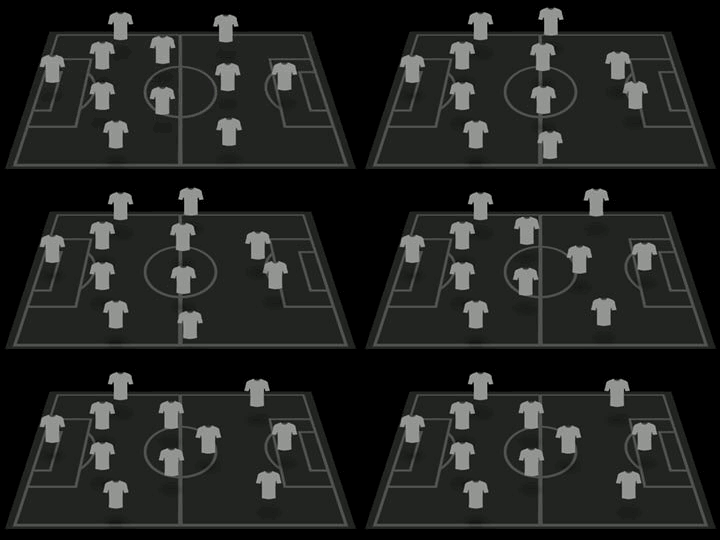
Two Sitting Midfielders
Since there are two deep lying midfielders instead of the usual one that might be found in many other formation, the 4-2-3-1 creates a situation where there is usually two players positioned directly in front of the defence, thus making the team more defensively solid.
These two players in the holding midfield positions (6 and 8) can also very easily cover for wingers and fullbacks when they get into attacking positions
Allows the use of a Number 10
Several popular formations these days do not provide room or a role for a typical number 10.
In this formation, the player in the “hole” or behind the striker has the responsibility of orchestrating the play and being a creative outlet for the team.
They have a direct central position that is not found in most variations of a 4-3-3, 4-4-2, 4-5-1 etc.
They need to be able to link with the holding midfielders, the flank players and the striker seamlessly.
Weaknesses of the Formation
Lone Striker
Since the formation usually has only one top striker who has to wait for the ball, it is very easy for him to become isolated.
If the striker does not know how to bring others into the game or have the technique or strength to do so, the team will find it difficult to transition the ball into the final third or relieve pressure.
Types of Players Required for the Formation
To achieve a proper balance (the team can attack without being easily countered, and can transition to offense efficiently from a defending situation) with this formation, there are certain requirements for each position that should be adhered to.
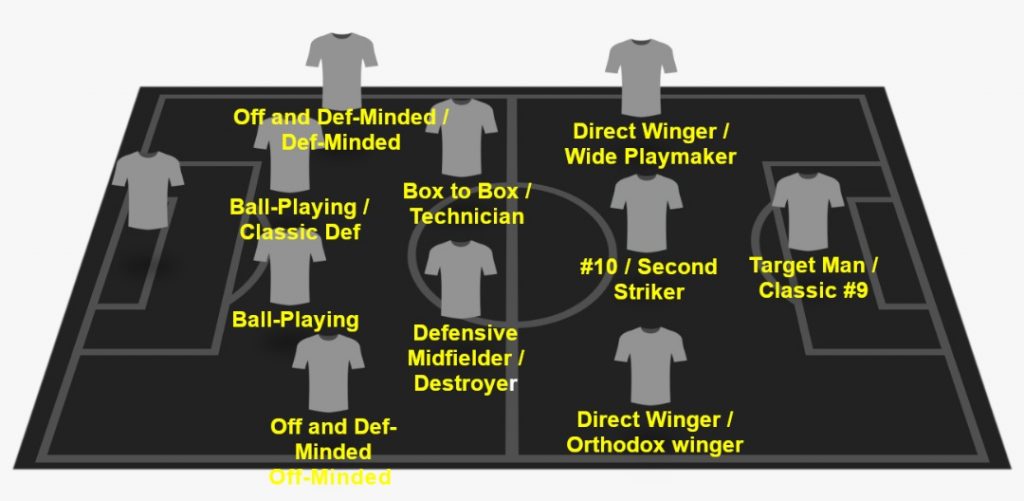
The top striker has to be able to hold up the ball, so it is common for a target man or very technical classic number 9 to be used in the position.
The player in central attacking midfield should be either a natural attacking midfielder/10 or a second striker (a striker that supports the main striker and has the tendency and quality to drop deep).
The 3 players behind the striker in a 4-2-3-1 should consist of at least one creative player (which is usually the number 10) and direct or orthodox wingers.
If the player in the number 10 role is not as good enough of a playmaker as necessary, the responsibility is usually shifted to one of the flank players.
The two holding midfielders should be a defensive midfielder and a box to box player, or defensive midfielder and a technician (technical player who can control the pace of the game).
This will bring adequate balance to the midfield.
On defence, at least one full-back should have be offensive minded, while the centre-backs should have the ability to play out of the back if possible, while still being tenacious in defence.
How the Super Eagles are likely to Line up Relative to these Requirements
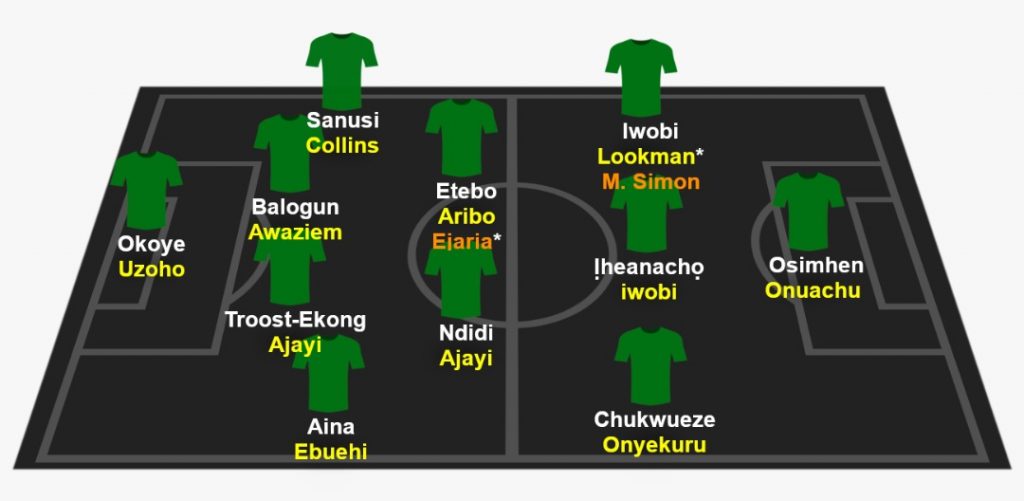
In the above graphic, the names written in white make up a potential starting eleven for Nigeria while also taking into account the players’ qualities relative to what is required of the position. The player names written in yellow and orange are also alternative options and possible substitutes that the Super Eagles could use, and who still fit the mold of the formation.
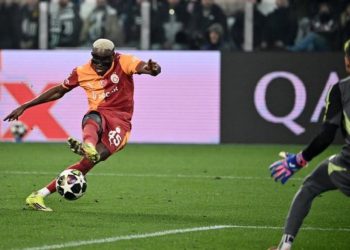
Looking at each position, one by one, and starting from the number 9 position (the striker), Victor Osimhen starts on top.
He has shown to have quality target man traits throughout his career so far. He has good size, and has proven to be a handful for defenders on his own on several occasions.
Most importantly, he has shown that he can bring others into the game.
His ability to play as a lone striker means his team can now have more players in midfield without a drop in quality in transitional play.
They will also be able to rely on him to tuck away goal scoring chances as he is likely to get several with three players instructed to create for him.
The same could be said for his alternative, Paul Onuachu, who at 6 feet 7 inches stands an imposing figure and a huge aerial threat.
In central attacking midfield/10, the position calls for either the usual natural playmaker that we would expect in the role or a supporting striker.
With the resurgence of Iheanacho as a consistent performer at club level and with the creative ability he has displayed throughout his football career, he has shown that he can play a supporting role to a striker.
He is technical and intelligent enough to link up with everyone around him even from a slightly deeper position.
Having played a similar role alongside Jamie Vardy at Leicester City, Kelechi Iheanacho can be expected to do the same for Osimhen.
The other player on the Nigerian team who can fit in this role, and who is probably the most natural for the position, is Alex Iwobi. He has the technique and creativity that can be truly utilized in a formation such as the 4-2-3-1, which allows for a natural 10 and makes them the focal point of chance creation.
It is a position he can surely excel in and it gives Nigeria another option.
At left midfield, Iwobi is there once again, but this time it is to both accommodate Iheanacho, who is in too good of form to drop, and to make sure that the necessary creativity exists amongst the three players behind the striker; this in turn makes sure the three are balanced in terms of quality and attributes.
On the other flank is Chukwueze who, in comparison to Iwobi, provides a more direct option which again increases the overall balance of the players behind the striker and the midfield in general.
The amount of tricky wingers in Nigeria’s arsenal does not end with Chukwueze, because as evident by the above graphic, Nigeria is full of them, and the 4-2-3-1 formation handles this well because it allows for two wingers.
With substitutes and alternate options like Henry Onyekuru, Moses Simon, and even the possibility of Ademola Lookman, it is necessary that the formation that the Super Eagles use includes wingers.
Making up the double pivot of this system are Wilfred Ndidi and Etebo — a ball winner partnered with another very hard working player who can transition the ball forward and get up and down the pitch easily.
Ndidi is capable of playing box to box, but in this formation it is recommended that somebody carries out more of the defensive responsibility and he has the ability to do so in spades.
The combination of these two players creates the balance necessary that will protect the back four and also allow the attacking players ahead of them to be at their most creative. Players such as Aribo, Ajayi, and possibly Ejaria also give great rotation options.
As full backs, both Sanusi and Aina have shown to be competent enough defensively, with the latter being more astute offensively.
While not always the most enterprising when going forward, the formation suits them most as it is a 4-at-the-back formation and since that is their natural position there are not many alternative to it.
The same can be said for their rotation options, Jamilu Collins and Tyronne Ebuehi.
Troost-Ekong and Balogun form the centre-back partnership with both being okay enough defensively and on the ball to make the 4-2-3-1 formation comfortable for them.
Awaziem and Ajayi could act as possible backup who would also do well in the formation. As goalkeepers, Okoye and Uzoho would be without noticeable hindrance in most formations.
Do their Tactics take Advantage of the Strengths of the Formation?
There are several ways in which Gernot Rohr’s tactics play to the strengths of this formation.
Offensively, Nigeria’s style of play is usually a mixture of direct and indirect. Because there are a high number of players in midfield, it gives Nigeria the best chance of have a good amount of possession. Having the numerical advantage (or not having a disadvantage) makes it easier to keep the ball, which is something that the 4-2-3-1 provides.
At the same time when they decide to play direct to their number 9, they will have enough players around him to go for the second ball, flick on or lay off.
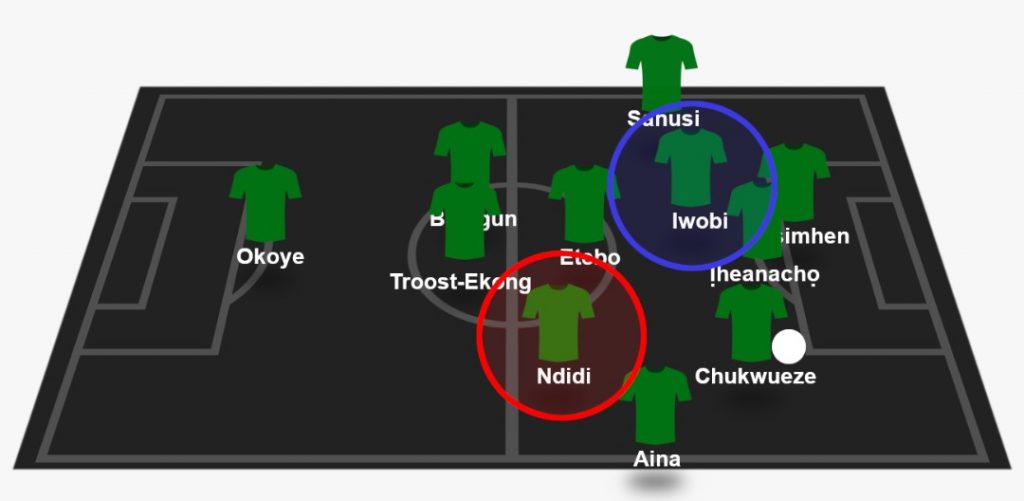
The Super Eagle’s tactics also involve giving Iwobi the chance to roam into the middle, and since this formation is very fluid, it gives the chance for Iheanacho to join the Osimhen in attack and vacate the center for Iwobi.
This fluidity also carries on to substitutions, as it will allow the Gernot Rohr to play with both Osimhen and Onuachu together if he needs to. In such a scenario, it would be easy to sub on Onuachu for the player in the 10 position and effectively turn the formation into a 4-4-2.
The formation can also become more attacking by telling the flank players to stay higher up the pitch, which would in turn make it a 4-3-3.
Nigeria also like to attack direct from wide positions with tricky wingers, so it is important that defensively this formation is able to provide the necessary measures to prevent counters incase the wingers lose the ball.
It is easy for the two players in the holding midfield position to shift and make sure their side is not open.
The two sitting midfielders also make 4-2-3-1 a very useful formation as Nigeria mostly use a mid-block, so they need to be able press and win the ball before it gets into their defensive third.
The graphic below illustrates Iwobi’s position when he drifts into the half space and Ndidi’s position when he makes sure his side of the pitch is secured from counters.
Conclusion
Overall, there aren’t really any players in the Super Eagle’s squad who would not be accommodated by this formation.
The 4-2-3-1 would make sure that players are always in their best positions, while also providing several tactical benefits in terms keeping ball possession, being more defensively solid and resistant to counters, and allowing for quick changes of shape and practical substitutions.
By Adeyanju Abiodun Instagram: adeyanju026
NOTE: SUPER EAGLES AND 4-4-2 FORMATION (PART 2) WILL BE PUBLISHED WEDNESDAY, AUGUST 11, 2021