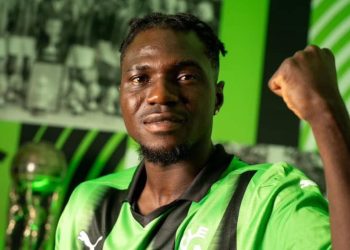
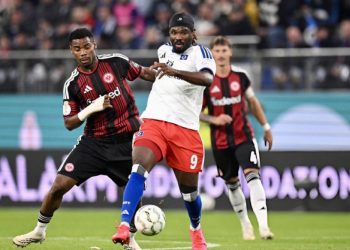
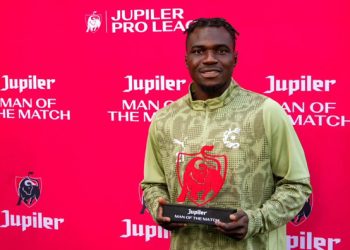
At 21, FC Lorient striker Terem Moffi has been one of the revelations of the season in Ligue 1. He took the time to discuss his season and present his journey which led him from Nigeria to Brittany, via England, Lithuania and then Belgium.
After a difficult start to the season, you’ve been scoring goals since Christmas. What has changed for you?
I believe nothing has changed for me. It is above all the team who have grown. When we watch our matches, we are much better since the winter break. We did not think about survival, but first of all to progress as a team. Obviously, it’s easier to score when the team are performing well.
You started very well against Reims for your first match, then you didn’t find the net for the next nine matches. How did you go through this period?
It was difficult for me, but also for the team. I needed to exchange with my family and my friends. Being a substitute and relegated to the rank of second striker was something I had never experienced before. I spent a lot of time in the gym trying to be stronger.

We imagine that your first experiences in Europe helped you a lot.
It helped me enormously! Lithuania was a crazy experience. I was barely 18 years old. I was from England and found myself in a country where no one spoke English, with food that you don’t really know (Laughs). It was very hard, really hard. However, I am a curious person who loves discovering new places. Looking back, it was a good challenge to face.
Lithuania is not a common destination for young players. What got you there?
One of the coaches at the school I played in England got a job in Lithuania. He was looking for an attacker and told my agent about it. When we talked about this opportunity, I said to myself: “Why not try to become professional there? So I left in the summer of 2017.
You arrive in Kaunas but left the club barely five months later. What happened ?
It is clear that it was not a great success. When you are a goal scorer and only score once in eight matches, it is inevitably disappointing. I had to leave the club in January 2018 and I went to test in France and Belgium. But it didn’t work out and I had to go back to Nigeria to renew my visa and try my luck again.
How do we go through such a disappointment so young?
When you are so disappointed, there are only a handful of people who can actually figure it out. My closest friends and family. I went back to see them and they always kept me motivated. They urged me not to give up training, to continue playing football. All the credit goes to them.

A year after your failure in Kaunas, you got another chance at FK Riteriai, still in Lithuania.
The last game I played with Kaunas was against this club. And it turned out that I really had a great game. Back in Nigeria, I got a message from the club’s sporting director on Facebook saying they were looking for a player of my profile. We took care of the paperwork and the visa, and I went for it.
You fired 20 goals in 31 matches and left for Kortrijk and Belgium in January 2020. Was it an accomplishment?
I also had offers in Norway and Sweden, but for me, the Belgian Championship was more interesting. I wanted to take an important step but I saw it above all as one more step towards a major league.
What did you learn from your time in Lithuania?
That it doesn’t matter which Championship you play in. If you can score, you can do it anywhere: in Lithuania, in Ligue 1, in La Liga … My parents always kept telling me that I should not be negative. This mentality has been ingrained in my mind since the start of my career.
In Belgium, the level was higher but you did not need to adapt.
It was amazing. In Lithuania, the season ends in November because of winter. I left for Belgium in January so I played 18 months in a row. It was trying, but I immediately managed to score and string together the good matches. I immediately felt very good in Kortrijk. There were two Nigerians (Imoh Ezekiel, Abduljaleel Ajagun) in the team who made everything easier for me. Without them, it might not have been the same. I owe them a lot

Last September, Lorient showed interest in you. Was this choice obvious to you?
After my six months in Kortrijk, I had a lot of proposals. We had to weigh the pros and cons of each of them. Unlike other clubs, Lorient offered me playing time and that was my priority. You can’t progress by staying on the bench. Coming here was the best possible choice.
Was it easier to adapt to Brittany than to Lithuania?
The first days were not easy. Here in France, you don’t really like to make the effort to speak English (Laughs). But as I went along, I figured out how to cope. And then my teammates, Wissa in particular, helped me a lot to adapt. I spend most of my time with Yoane (Wissa), Trevoh (Chalobah), Armand (Laurienté) and Adrian (Grbic). We stay together like any family does.
At the end of December, the club was in very bad shape. How has the coach kept you all involved and motivated?
He did his best to keep us in a positive frame of mind. In the first part of the season, we did several good performances without getting any results. It was very disappointing. But in football, you just have to win a match for that to change. That’s what we did. Since then, we have taken points almost every game. But we still have a long way to go if we want to play in Ligue 1 next season.
Back to your performance. Between late December and early January, you scored in four straight matches. However, you did not start the match against PSG. How did you experience it?
I just told myself that the coach was the boss and that was his tactical choice. He knows the team and he knew that I had just finished four matches. We had a lot of meetings to play after PSG, I also had to rest. Not everyone can play all the time. I had no problem with his decision, he took the time to explain it to me. And it was the right one.
Tell us about this last goal.
It’s the biggest goal of my career so far. Against a club that I see playing in the Champions League, players that I admire … To score against PSG in this way, it was incredible. On the way out, I had a great opportunity but I rushed. After the meeting my father asked me why I had been so fast. He said to me: ” When you are in front of the goal, you have to take your time .” From the moment I took the ball off the halfway line, all I had in mind was, “ Quiet, quiet ” (Laughs). We had to continue the race and do the right thing.

What have you learnt the most since your debut in Ligue 1?
To become a more physical player. Here, you have to be solid when you receive the ball in front. We don’t always have a lot of space and time. You have to get the information in advance to be in the best possible condition when the ball arrives.
The club won against PSG, but also earned draws with Lyon, Rennes and Monaco. So you are ready to challenge the best defense in Ligue1 (Lille)?
It’s a matter of state of mind. When you play against these big teams, you often have to back down. But you have to know how to seize the slightest opportunity to hurt. Against Lille, it will be a difficult match. But I’m sure they’ll be afraid of us too. We have to keep this confidence and give everything on the pitch.
Adapted from France Football