SCORENigeria in-house match analyst Adeyanju Abiodun runs the rule on the Super Eagles display against Cape Verde in a decisive final 2022 World Cup qualifying Group C clash against Cape Verde in Lagos.
There is still a lot of work undone for the Eagles to fly all the way to Qatar 2022.
Line-ups
Nigeria
Formation: 1-3-5-2
Starting XI: 1 Maduka Okoye, — 20 Chidozie Awaziem, 5 William Troost-Ekong (Captain), 6 Leon Balogun — 15 Moses Simon (Shehu Abdullahi 68’), 10 Joseph Aribo (Frank Onyeka 78’), 4. Wilfred Ndidi, 18 Alex Iwobi, 3. Jamilu Collins — 9 Victor Osimhen (Paul Onuachu 89’), 8 Odion Ighalo (Kelechi Iheanacho 78’)
Substitutes: 1 Daniel Akpeyi, 23 John Noble, 11 Samuel Chukwueze, 21 Frank Onyeka, 14 Kelechi Iheanacho, 12 Shehu Abdullahi, 13 Zaidu Sanusi, 17 Chidera Ejuke, 7 Ahmed Musa, 2 Kevin Akpoguma, 22 Kenneth Omeruo, 19 Paul Onuachu
Cape Verde
Starting XI: 1 Vózinha, 2 Stopira, 7 Patrick Andrade (Nuno Borges 60’), 22 Jeffry Fortes (Willy Semedo 60’), 4 Steven Fortès, 3 Roberto Lopes, 20 Ryan Mendes (Captain) (Gilson Tavares 66’), 10 Jamiro Monteiro, 15 João Paulo Fernandes (Vágner 76’), 18 Kenny Rocha Santos (Nenass 66’), Júlio Tavares
Substitutes: Willis Furtado, Gilson Tavares, Vágner, Steve Furtado, Dylan Silva, Diney Borges, Nuno Borges, Márcio Rosa, Willy Semedo, Nenass, Dylan Tavares, Marco Soares
Yesterday, at the Teslim Blogun Stadium in Lagos, the Super Eagles went into the final game of the group needing a draw to qualify for the World Cup playoff round.
Cape Verde, who they had already beat in their first meeting in the group, were also looking for a qualifying spot, sitting second in the group behind the Super Eagles.
A goal by the first minute from Victor Osimhen gave the impression that it would be a simple encounter for Nigeria, but Cape Verde, quickly showed why they had not lost in their six previous straight away matches and equalized shortly after.
In a match that saw Nigeria struggle to break down Cape Verde’s defence after the equalizing goal, the Super Eagles came away with a 1-1 draw, which was enough to give them a spot in the World Cup playoffs.
Tactics
System and Personnel Changes
While the Super Eagles went with a 1-3-5-2 formation, they only saw one major change in personnel and that was Odion Ighalo in the place of Kelechi Iheanacho.
Ighalo was to make his return to the starting eleven after his recent return to the national team.

Open Play
Nigeria continued with their usual combination of a mixed direct and indirect style of play.
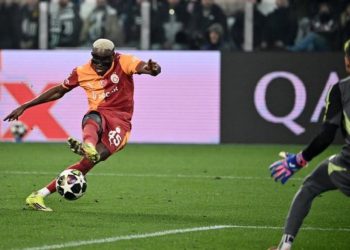
Their use of a 1-3-5-2 formation also emphasized the use of width in their game plan. From both wide and central positions, Victor Osimhen was usually the primary target, and this tactic worked immediately as an early cross from Simon Moses saw Victor Osimhen score in the first minute of the game.
After a Cape Verdean defender mistimed his header on the cross from Simon Moses, Osimhen was there to put the ball into the back of the net.
Throughout the match, direct balls were played to Osimhen, who would then try to singlehandedly force his way through the opposition’s defense.
In the match, Nigeria transitioned the ball from defence to the midfield mostly through Wilfred Ndidi (he was usually the first to receive the ball in the midfield third). The team relied mostly on Alex Iwobi and Moses Simon to provide creativity and to help transition the ball into the attacking third. That is, when the ball was not being hoofed to the strikers.
Collins and Moses Simon, who were being used as wingbacks, had the job of trying to create from wide positions. Simon’s position of wingback in this match however negatively influenced his attacking contribution on the game (despite the fact that he helped create the first goal).
He was not able to take on the opposition as much as he normally would, as he found himself having to defend more frequently.
On defence, Nigeria used their usual mid-block tactic. They allowed Osimhen to do a lot of pressing from the front. Their use of five players in midfield allowed them to have a lot of numbers and stay compact especially when it came to stopping the opposition’s counter attacks.
Despite this, there were still many occasions where the midfield dropped off too much, especially in the latter stages of the game.
Offensive and Defensive Positioning
Nigeria’s 1-3-5-2 formation allowed the team to have maximum width when attacking, but also to have five players in their defensive line when defending in their final third.
The two strikers both stayed high without one seeming to take a more withdrawn role.
The three men in central midfield (Iwobi, Ndidi, and Aribo) were set up in a triangle with Ndidi playing as the pivot and the two other midfielders (Aribo and Iwobi) playing ahead of him.
Iwobi had more of a license to go forward than Aribo, and he would often move centrally and play behind the two strikes, Ighalo and Osimhen.
Defensively, even though the Nigeria were playing with three defenders at the back, it was common to see Awaziem, the right center back, shift out wide to compensate for Simon Moses’ lack of defensive shortcomings.
Set-Pieces
Nigeria were quite poor in this regard. The equalizing goal came from a Cape Verdean corner kick.
In the sixth minute of the match, Troost-Ekong lost his man, Stopiria, and allowed him get goal side before the latter placed it into the net.
It is always a very serious mistake in football when the opposition player scores with his foot in or just around the six yard box during a corner kick. This is because it means that the overall defending of the team was so poor that none of them were able to get their head on the ball while simultaneously allowing enough space for the ball to drop to the feet of an opposition player.
The Super Eagle’s use of man-to-man and zonal marking did not prove effective this match as the player meant to stay tight with his man did not succeed in doing so and some of the players that were meant to mark certain zones were protecting areas where there was no danger.
Corners from the right side of the pitch were taken by Simon Moses, who provided outswingers, and corners from the left were taken by Alex Iwobi who provided inswingers.
The crosses were inconsistent overall.
On some occasions, the Super Eagles opted for the long throw.
Goal kicks were often taken long unless there was no pressure from the opposition. Often the keeper would push all the players to the center of the field. This showed how little risk that Nigeria were willing to take during this match.
Substitutions
In the 68th minute, Moses Simon was substituted for Shehu Abdullahi. While this substitution was likely due to injury concerns from Moses Simon, Abduallhi as a more natural defender was also used to help reduce the chances of conceding and maintain the draw.
Ighalo and Aribo were also substituted off for Iheanacho and Onyeka respectively in the 78th minute to bring in fresher legs.
Onuachu came on for Victor Osimhen in the 89th minute as a ceremonial substitution.
Team Performance
As usual, the team’s performance lacked fluidity and control. This was brought on by how frequently the team tried to play direct. So often, a long ball would be played to Osimhen, who would then try to go at it alone and often find himself in 1 v 3 situations.
To his credit he did manage, in some instances, to retain the ball, but the style of play was not very captivating.
Nigeria also struggled once again to control the midfield and the tempo of the game.
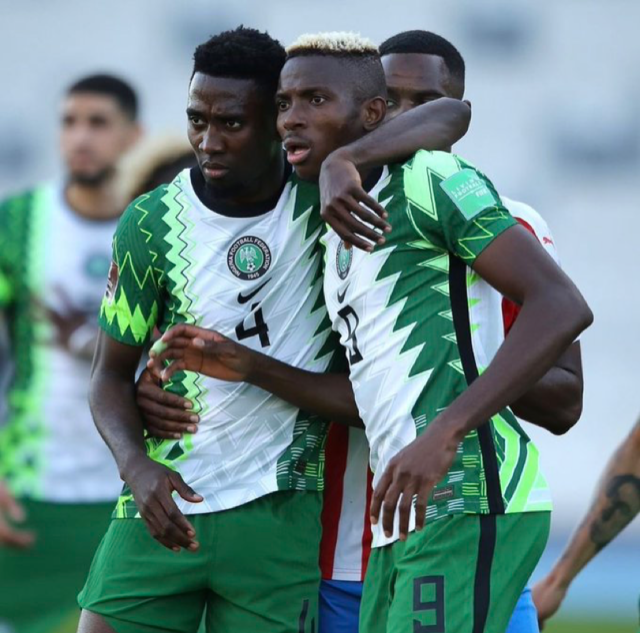
Despite playing a formation with five players in midfield and having, on paper, more adept midfielders, there were still many misplaced passes.
Many players on the team were easily disposed of the ball and seemed to struggle to play out of pressure.
Most chances created came from crosses (such as one from Victor Osimhen to Ighalo in the 33rd minute) and second balls.
It was clear that they struggled to break down Cape Verde’s defence.
The team also seemed to try to capitalize on set pieces such as in the 41st minute when Aribo made a nice header that led to a good save by Cape Verde’s goalkeeper Vózinha.
Defensively, Nigeria seemed to struggle with long balls played by Cape Verde as it often stretched their defence.
This was especially the case in the last minutes of the game.
Despite many faults in Nigeria’s display tonight, they still showed a lot of willpower and determination to get the necessary result, especially when the quick equalizer from Cape Verde is considered.
The Super Eagles still had the most chances in the game.
Notable Individual Performances
Victor Osimhen
He proved once again to be one the team’s main players and continued both his good club and international form by scoring immediately in the match. He showed a lot of strength on the ball, often taking on several opposition players at once.
Both his work rate, offensively and defensively, were exceptional; he seemed to never stop moving.
As long as the Nigerian national team continues to create chances for him on a consistent basis, he will continue to produce.
Odion Ighalo
His game was an interesting contrast to Osimhen. While the latter was always on the move, Ighalo had a slower pace to his game, as he exhibited his usual poacher style.
However, when he did get chances to score, he was not able to put the ball in the back of the net, putting a header off target in the 33rd minute and miskicking the ball when he was right in front of goal.
It was not his best performance, but it was also his first game back after a long period.
What We Learnt
While the team managed to finish with a 1-1 result, it was still not a commanding display.
The positive is that they finished top of the group with 13 points and they will now go into the playoffs round.
Perhaps performances will be more consistent going forward. It will be needed if they expect to make it to the World Cup in Qatar.